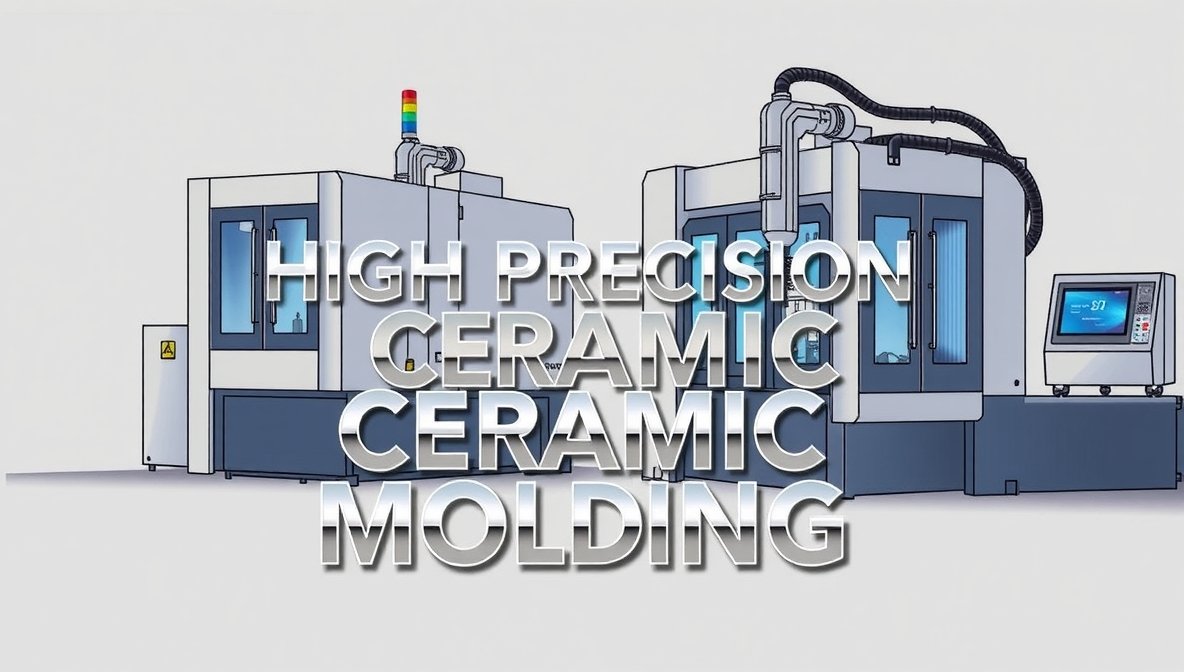
Ceramic injection molding (CIM) is a powerful technique that combines the shaping freedom of plastic injection with the superior properties of ceramics. This process is often associated with high precision ceramic molding, where even the smallest details and complex geometries can be achieved with remarkable accuracy. To understand the true potential of CIM, it helps to dig into the materials that make it work. In this article, I’ll walk you through some of the most common, and intriguing, materials used in CIM, including alumina, zirconia, and a few specialty variants. Along the way, you’ll find some fun surprises and insights you won’t forget.
The Role of Materials in Ceramic Injection Molding
Before diving into each ceramic type, it’s useful to appreciate why material choice is so critical in CIM. The raw ceramic powder, along with binders and additives, defines mechanical strength, density, thermal stability, sintering behavior, and final part performance. The technique borrows from plastic molding: a slurry or feedstock (ceramic powder mixed with binders) is injected into a mold, then the binder is removed and the part sintered at high temperature to densify it.
Material selection is a balancing act: you want high purity, good packing density, controlled particle size, and compatibility with binder systems. The ceramic “ink” must flow well but also consolidate without leaving defects. Different ceramic families bring different trade-offs.
Alumina: The Workhorse Ceramic
When you look at ceramic materials used in injection molding, alumina (aluminum oxide, Al₂O₃) is often the starting point.
Why it’s popular
- Alumina offers excellent electrical insulation, good thermal conductivity, and strong mechanical properties at relatively moderate cost.
- It resists corrosion, wear, and high temperatures, making it suitable for many industrial components.
- It’s comparatively forgiving in terms of shrinkage control and sintering behavior (fewer surprises in densification).
Trade-offs and challenges
- Pure alumina tends to be hard and brittle. Under shock or impact, failure via cracking is always a risk.
- Achieving full density (i.e. minimizing porosity) can be tricky, especially for complex shapes.
- The particle size distribution must be very tight to avoid defects in molding or sintering.
In the literature, alumina-based feedstocks are often the first choice for new CIM designs because of this balance of performance and manufacturability.
Zirconia: Strength, Toughness, and More
Zirconia (zirconium dioxide, ZrO₂) is often considered a “premium” ceramic. In many respects, it pushes the boundaries of what ceramic parts can do.
Key advantages
- Zirconia is known for very high wear resistance, excellent fracture toughness (for a ceramic), and good stability under pressure and thermal cycling.
- It can handle stress concentrations better than many other ceramics, making it favorable in demanding applications such as dental implants or structural ceramic parts.
- Its mechanical resilience and crack-resistance help it survive in harsher environments.
Trade-offs and difficulties
- Zirconia is more expensive than alumina, both in raw material cost and in processing demands.
- Its sintering behavior is more complex; achieving uniform densification without warpage or cracking requires stricter control of temperature, ramp rates, and atmosphere.
- The shrinkage is larger and sometimes more non-linear, demanding even more precise mold design and compensation.
Sometimes zirconia is alloyed or modified (for example, with stabilizers like yttria) to improve certain properties, particularly to stabilize its crystalline phases.
Hybrid and Specialty Ceramics: When Alumina or Zirconia Aren’t Enough
Beyond those two popular options, engineers often explore combinations or niche ceramics to get the desired performance without overpaying.
- Alumina Toughened Zirconia (ATZ) or Zirconia Toughened Alumina (ZTA): These ceramics combine the best of both worlds. The tougher zirconia phase helps inhibit crack propagation, while the alumina contributes hardness and stability.
- Silicon nitride (Si₃N₄) or silicon carbide (SiC): In more exotic or high-temperature applications, ceramics like Si₃N₄ or SiC may be used. They bring excellent thermal and mechanical performance, but are harder to mold and sinter, and often require very specialized processing.
- Bioceramics, piezo ceramics, and functional ceramics: For implants, sensors, electronics, or actuators, ceramics may include dopants or compositional tweaks for electrical or bio compatibility traits.
Each of these specialty ceramics pushes the envelope, but also demands more from the injection molding and sintering processes.
Fun Fact Fusion
Fun Fact: Zirconia is used in high-end ceramic knives because it holds an edge far longer than most steel blades. Its extreme hardness (on the Mohs scale nearing that of a diamond’s lower range) makes it an ideal material for precision cutting in certain applications.
Another interesting tidbit: the idea of injecting ceramic pastes into molds dates back to early 20th-century spark plug manufacturing, long before modern polymer injection molding techniques matured. That historical overlap helped drive innovations in today’s CIM processes.
Designing with the Right Material in Mind
Choosing among alumina, zirconia, or more exotic ceramics isn’t a simple “pick the strongest” decision. Here are a few guiding considerations:
- Load environment – Are you dealing with static load, impact, or cyclic stress? Zirconia’s toughness helps under cyclic stress, while alumina may suffice for static loads.
- Temperature and environment – For high-temperature or corrosive settings, the chemical stability and thermal expansion of the ceramic matter greatly.
- Dimensional precision and size – Large or intricate parts are harder to sinter uniformly, so simpler materials (like alumina) might tolerate process variations better.
- Cost constraints – Material cost, yield (defect rates), and process complexity all feed into the total cost.
- Post-processing needs – If you need tight tolerances, grinding, lapping, or finishing can help, but only if the ceramic can take the machining stress.
In practice, engineers sometimes prototype in alumina to test form and fit before upgrading to zirconia or a hybrid for final performance.
Material Matters in CIM
Ceramic injection molding gives designers a rare chance: combine complex geometries (via molding) with the high-performance properties of advanced ceramics. But that promise only delivers if the material foundation is sound.
Alumina gives you a robust baseline, relatively cost-effective and well understood. Zirconia raises the bar on toughness and wear resistance but demands more precision in processing. Hybrid ceramics and specialty compositions open new possibilities but bring complexity.
By understanding the strengths and trade-offs of each material, engineers can make smarter decisions, reduce failure risks, and push the boundaries of what ceramics can do in injection-molded form. If you’re exploring a new part or product that requires both complexity and high performance, the materials behind CIM are where your possibilities truly begin.